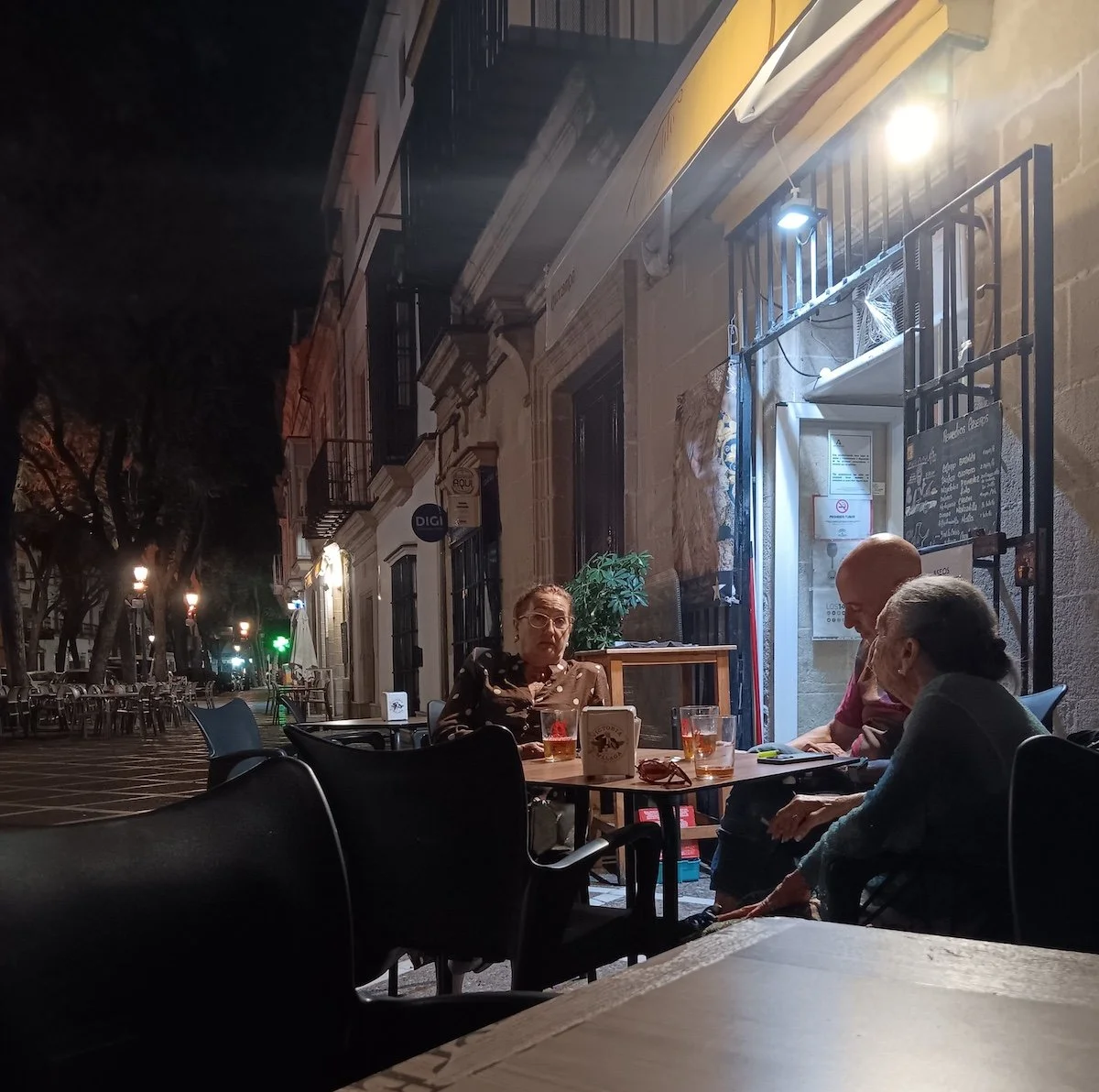
“We are not the biggest fan of Spanish food, we don´t like abandoned cities during siesta time, we are not happy with the late dining, around the garbage containers it´s dirty and smelly, there are loud Spaniards and dogs barking and dog poop everywhere, I dislike having dinner at a restaurant and having to shout at my wife because all the people around us are shouting.”
The question this gentleman was answering by way of a local Jerez Facebook group was from someone considering moving here asking, “What do you like about Jerez?”
It’s actually a valid and perfectly reasonable assessment – particularly if you’re a glass-half-empty kind of guy (or a grumpy whining turd, depending on your perspective) – but the same might be said of any city in Spain. To imply that Jerez somehow is unique in its high regard of siesta time, eating ‘late’, dog ownership (apart from a small unsavoury element, the Spanish are remarkably compassionate and considerate pet owners), and the bars being noisy (Spanish people sure do know how to socialise, but it’s not like there aren’t 100 conventionally quiet restaurants within walking distance) isn’t useful for the guy tossing up between Jerez and Gandia as his new home.
And, apparently to this bloke’s annoyance, there’s quite a lot of Spanish food in Jerez. As Basil Fawlty might ask, what did you expect, herds of migrating wildebeest sweeping majestically …
It’s like this guy saw the question as an opportunity to vent about a poor decision he made in moving to Spain, a country he’s not cut out for and will never appreciate. He went on to say that he and his wife have sold their house and are leaving the country soon, to which I’d say don’t let the door hit you in the arse on your way out.
I’ve written before about the nigh-impossible task of selecting a place to live in Spain that suits you solely from desktop research, or basing your decision on a three-week holiday you once had here. By all means use these devices to develop a shortlist, but there’s another step you should take before deciding on city X or village Y.
Live there for a bit.
By that I mean visit the place like you mean to live there. Three days in a hotel won’t cut it if you want to know what your future life might look like. Book a self-contained unit and spend at least two weeks in the one place, preferably four. And here’s the clincher: do it at the ‘worst’ time of year.
In some places, the worst time of year is also the best – but only when viewed through a climatic prism. I’m thinking of the beachside towns of the south-east, with their preponderance of British neighbourhood enclaves, one of which might immediately find its way to the top of your shortlist because you hear about it on YouTube. But come summer these towns are crawling with visitors and you won’t find a table at your favourite bar. In fact, any beachside town in Spain in summer can be a nightmare for the locals – one of whom you intend to be, don’t forget – which was very much the case for us when we lived in San Sebastián. We couldn’t move for French/British/German/American tourists from July to September, and for us the city quickly lost its shine. We made sure we were outta there before the commencement of our second summer.

The queue for Bar Nestor in San Sebastián.
In other places, the worst time of year is winter; northern Spain rain, for some, is plainly a pain in the brain, even if summer is as close to a perfect climate as you can hope for.
In Jerez, the ‘worst’ time is summer, but again only from a climate perspective (the summer festivals here are incredible, with events held exclusively in the evenings). From 10 am until 8 pm during one of the frequent heatwaves it’s stupidly hot outside. Of course, the locals in Jerez – as they’ve done in the rainy north – adapt, which is something you can’t get a feel for unless you live it. If it’s not a work day they’ll run their errands in the exquisite mornings then head home, lower the blinds and close the windows, and let the sweltering daytime pass them by. When the sun goes down so does the temperature; only after dark do the locals venture out for drinks, dinner or a show. Seriously, there’s not much action here in summer before 10 pm; many restaurants open at 8 or 8.30 pm but if you go at that time you’ll likely be on your own, with staff often seeming a little startled and not quite ready for you.*
The local social media forums are peppered with foreign veterans of two or three Andalucían summers asking where they should move to instead, having realised that the ‘lovely beach weather’ that attracted them, when experienced continuously for four months, can actually be quite demanding on one’s ageing carcass.
If you’re serious about making a permanent move to Spain, choose a place to visit and remain there for two, three, four weeks. Unpack your clothes. Find the local market and cook with its produce. Go not repeatedly to that bar you found because the guy there was super friendly but to many bars. Don’t get annoyed when they don’t have the type of red wine you’re used to – order what the locals drink. Learn the local words for a beer (in Jerez, maceta) and for goodbye (the rather shortened ha’ luego). Sleep late, eat late, go to bed late. Do nothing for a day. Catch a local bus to the town down the road. Do it all again.
Don’t be fussy. If you won’t eat a medium-rare hamburger, don’t order the hamburger. Meals here come as they are. Don’t like eating pork? Even the vegetable dishes in Spain will come with a smattering of jamón on top, or at least will have been cooked in pork fat. Telling a waiter that you can’t eat pork will just confuse.
There’s a lot to be said about the benefits of slow travel, but never so much as when you’re plotting the perfect permanent placement. Immersing yourself in the culture even just a little bit gives you the best shot of making the right decision about the move of a lifetime. You get to see the reality, not just the brochure.
Our mate with the long list of dislikes fucked up worse than most, in that he got his immigration destination wrong by a whole country, not just by a whole city, but the principle stands. He made an expensive mistake because he failed to do the groundwork.
Your best bet if you’re feeling out a move? Travel like you mean to live.
_____________
* It gets dark relatively late in the day in Spain, thanks to good old Franco in 1940 electing to switch all the clocks back an hour to Nazi German time; for some reason they never switched it back to the correct zone. It’s another reason the Spanish have a reputation for eating late – it’s not dark till well after it should be.
