The simple food of Cádiz
This is a restaurant review, and at the same time it isn't. I’ve avoided writing-up in detail most of the places we regularly frequent for the simple reason that the menu can change at the drop of a gorra and before you know it the winter partridge you’ve raved about has flown the coop. Keeping a restaurant review current is one thing. Keeping 50 restaurant reviews current is 49 more. (I’ve made some exceptions – see here for our current top three, plus there’s my map of places we keep going back to.)
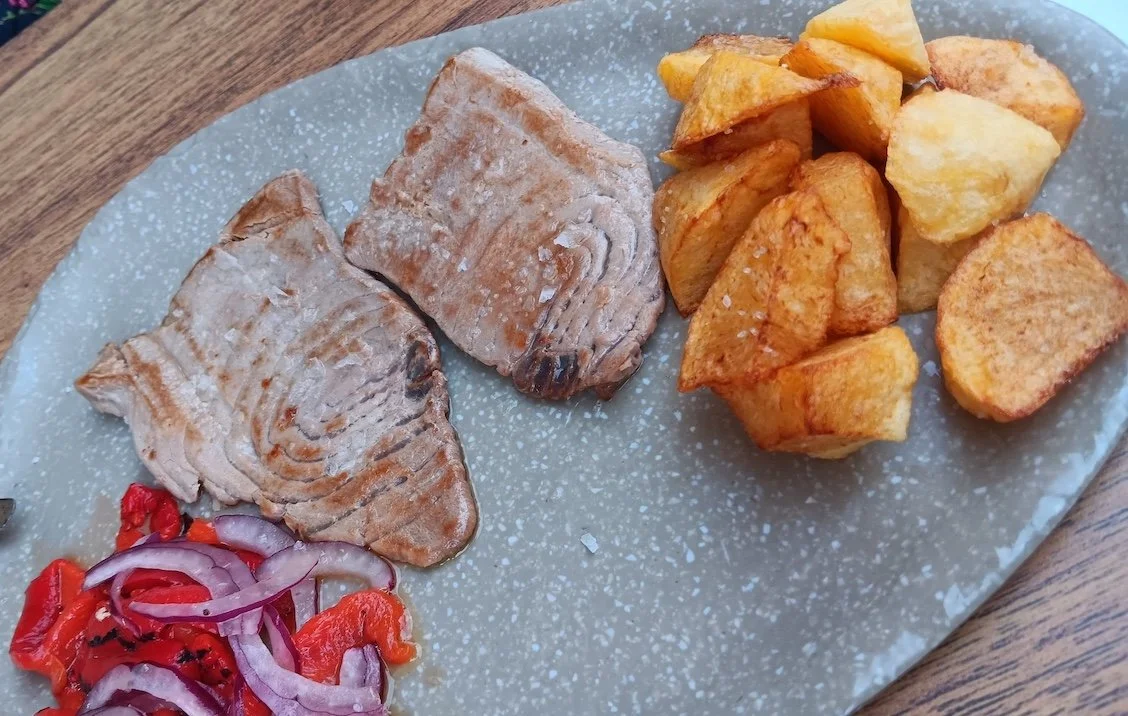
But last night we found a dish that we both thought represented the summer cuisine of the Cádiz province so well that it warranted having its picture painted in words as well as pixels. Because, as you’ll see from the photo, good food doesn’t necessarily need to look like it’s been meticulously sneezed out of Marco Pierre White’s Michelin-sized nose.
So here it is. Two lumps of tuna, some chips, and a salad of onion and roasted red-pepper (aka capsicum, if you’re an antipodean like me).
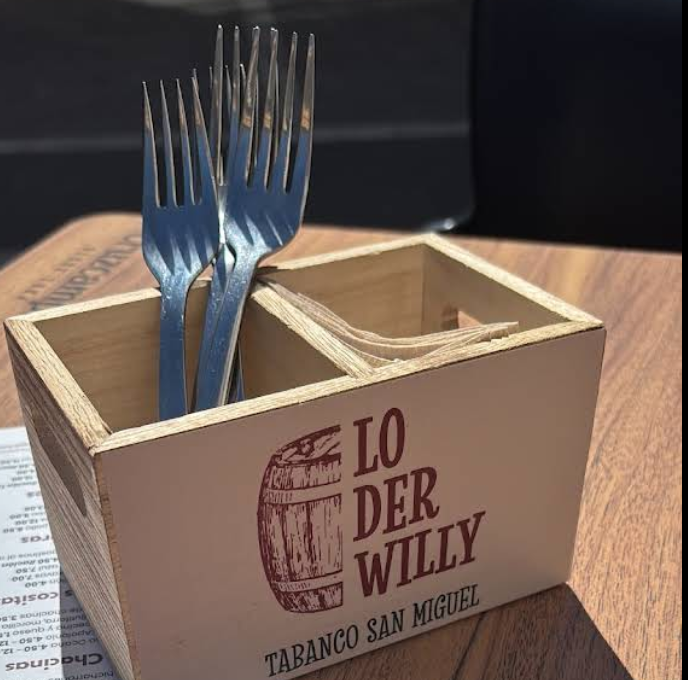
This particular plate is to be found at one of our favourite places, Lo der Willy, which translates roughly as ‘there’s something about Willy’, and not, as you might suspect, ‘load of willy’. (Willy is a famous ex footballer trying his hand at the restaurant business and scoring a hospitality hattrick in his first outing.)
Caught each spring in a complex labyrinth of nets as they swim close to the coast around Barbate, just down the road from us, the famous red tuna is a delicacy in these parts; half the bars and restaurants throughout the Cádiz province offer an atún rojo invention during the middle of the year. We’ve had it sashimi style and cooked to varying degrees, as a tapa in a hole-in-the-wall bar and as a main at some of Jerez’s finest la-di-da tableclothed establishments. It typically comes with minimal fussiness, perhaps just with a bit of oil, salt, maybe a herb or two, but often with absolutely nothing to embellish it. It’s dynamite, however it’s served, with the complements of provenance and freshness amplifying the enjoyment by a significant factor of smugness.
Fun fact. Until recently the Spanish rarely ate red tuna. They just didn’t really fancy it, instead opting to sell their catch to the Japanese market. One day, in an uncharacteristic lack of foresight, the Japanese purchasers made a critical commercial error: they showed the locals how to butcher and properly prepare the fish for eating. Virtually overnight the fishermen of Spain ghosted their foreign clients and the export market evaporated, much to the annoyance of the Japanese and the utter delight of the people of southern Spain.
The tuna in the photo has been seared in a hot plancha and plated with a sprinkling of course salt. It’s a media ración, a half portion, bigger than a tapa. And while you might think the chips and salad are side dishes, let’s get back to my reason for spending a considerable chunk of my Sunday afternoon writing when I could be watching The Americans with Jess:
The chips and salad ain’t just sides.
Potatoes are revered in Spain, nowhere more so than in our province. The conquistadors brought them back from South America in the 16th century, initially via Seville, and after a few false starts the populace decided that potatoes were more than just food for the donkey. Fortuitously, these babies grow to extraordinary quality in the salty sandy soils of coastal southern Spain, and nowhere better than in the town of Sanlúcar, also just down the road from us.
Australian soils are really old. They’re naturally deficient in phosphorous, nitrogen and multiple trace elements. To grow food in Australia you need artificial fertiliser, and the end result is a bit blergh. This is not the case in most of Europe, which is why the dramatic superiority of the flavour of the veggies here isn’t just in our imagination. The carrots taste like carrot, the tomatoes like tomato. Fruit and vegetables here are denser, sweeter, and generally have more flavour than they do where I’m from. Even the humble potato. They have this silky quality, a kind of melt-in-the-mouth unctuousness, that makes them the perfect accompaniment for stews; you’ll find them beneath just about every tapa of pork cheek or steak, deliciously soggy, absorbing the sauce’s flavour and accelerating it along the way. Even deep-fried chips are unapologetically soft, not crunchy like you might be used to. This is not because, as I once overheard a knowledgeable American explain to his friends, ‘the Spanish don’t know how to make fries’. Of course they know how to deep fry a fucking tuber! But when the tuber in question is delicious in its own right there’s no need to.
In this case, our fried potatoes represented the second act of a three-act play, as long as you can imagine a play in which everyone talks at once and each act finishes at the same time. And you can drink while you watch it.
The third part is the salad. In Spain, roasted capsicum routinely takes the place of a sauce. It’s soft and sweet and offers a simple alternative to a pan sauce that will leave Marco Pierre White wondering why he bothered coming in to work today. Augment it with a little onion and some of the best olive oil in the galaxy and you have something that ET would phone home about.
It cost €12. The majority of the tapas at Lo der Willy are about €4.50 – but remember, this is a media ración of a supremely sought-after seafood. It’s absurd to think you could buy something that tastes this good for this price back in Australia.
This approach to food is Spain all over. The summertime cuisine of Jerez, while literally unique in many ways (sherry offering an unfair advantage with its application to sauces and dressings), is no better or worse than what you’ll find in the rest of this colourful country. But people round here are especially proud of the ‘simple things done well’ paradigm because their simple things are extraordinary.
Hence, this rather long and overly praise-ridden post about some fish and chips. It’s okay if you decide I’m talking a load of willy.
