A pattern language
Some random YouTuber popped up on my feed the other day, an American guy living in Paris. He made the observation that the French’s reputation for rudeness was thoroughly undeserved, and the alleged victims of the rude behaviour in effect brought it on themselves by being rude first.
His example was of an American tourist. On gaining first place in the queue at a bakery, he said ‘I’ll have a baguette and two croissants please.’
Prima facie, perfectly polite by American and UK and Australasian standards, right?
Well, not really. Our vlogger noted two errors. The first and most obvious: you spoke English? Expected the server to just understand you? Obnoxious twat. That said, even had the request been in French we soon discover another problem.
The French would never lead with ‘I’ll have a …’ Almost without exception, a French customer will not begin a transaction with a demand. Instead he will say bonjour, then wait a beat for the server to respond in kind, before placing his order.
In the eyes of a French retailer, our American customer was the one who behaved rudely by not offering a polite greeting. Apparently everyone in the bakery noticed, and glared accordingly in solidarity with the server. The American guy in his mind concludes that the French are rude. He didn’t understand what Jess and I have come to call ‘the pattern’.
(A year ago I wrote a post on how absurd it is that the universal piece of advice for people moving to Spain is ‘learn Spanish’. It’s an extremely simplistic and unhelpful demand.)
In Spain, retail transactions aren’t like those in France, and certainly not like those in Australia. The patterns are different – but they exist, and you would do well to understand them before you worry too much about the language itself; you could be a Duolingo master but still annoy a local and embarrass yourself because you’re doing it wrong. For any given definition of ‘it’.
Here’s an example of a pattern the way we experience it, in – for reasons which would be obvious if you knew us – a bar.
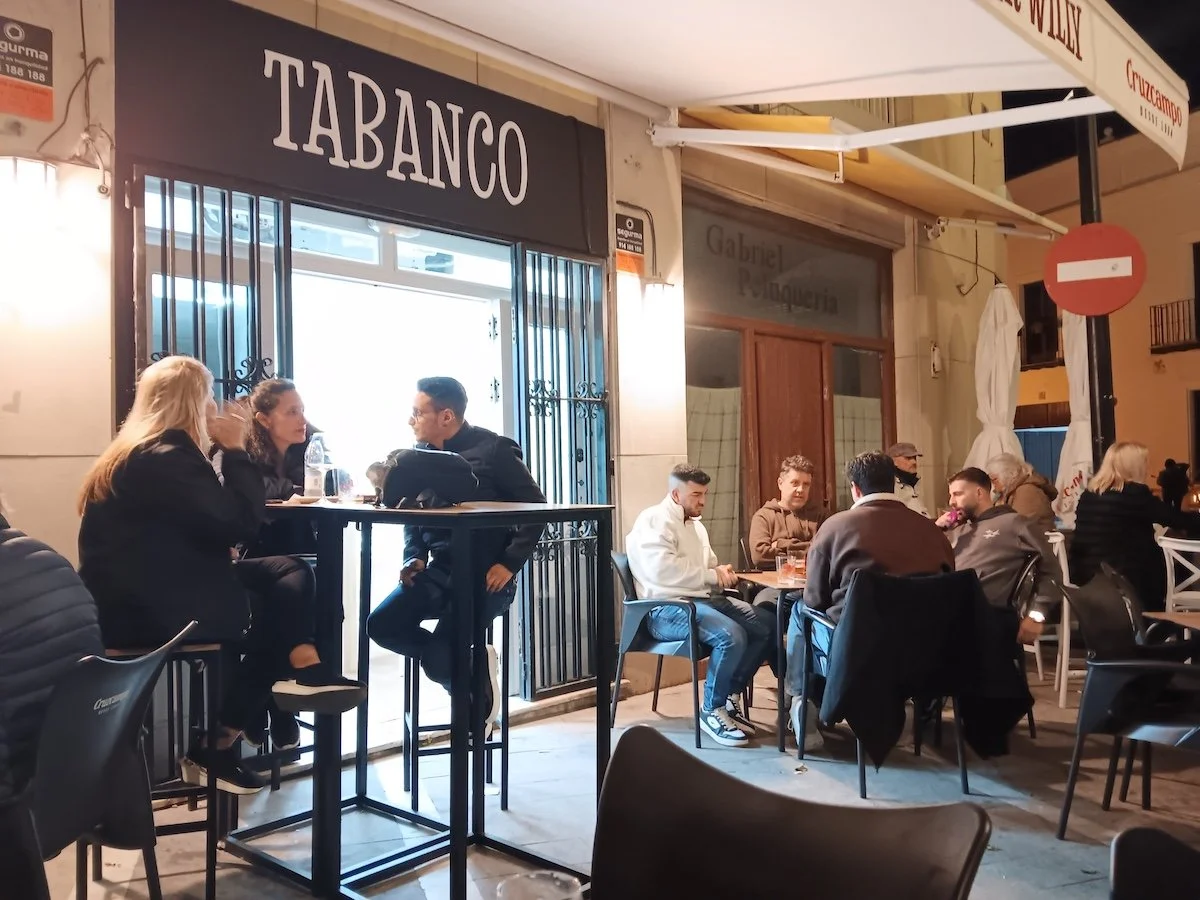
Eye contact among bar staff works differently in Spain. Sure, if you walk into a quiet bar and the barman is right there you’ll get a friendly buenas. But if you sit at an outside table at a busy bar you’ll notice something odd by the standards of we Aussies, or indeed by those of our northern English-speaking counterparts.
It’s not unusual for wait staff to completely ignore you.
This isn’t rudeness. Or unprofessionalism. I can assure you that in a country like Spain, where the citizens’ average food literacy outstrips that of our own home countries by an order of magnitude, they know a thing or two about feeding people and fostering maximum enjoyment and satisfaction from a session at a restaurant.
The waiter knows you’re there, even if he doesn’t acknowledge you. He will be with you when he’s finished whatever he’s doing. His own work is important too, so if it’s inconvenient for him to drop everything merely to convey that American-style false sense of the customer as king, he won’t do it. If he’s not looking at you, he’s not ready to talk to you. He isn’t your servant, he’s your server.
Soooo often we see tourists craning their rubber necks, raising a demanding hand or fidgeting in their seats, trying to attract the attention of a (seemingly) oblivious waiter. They begin to get visibly frustrated; you can virtually hear them muttering, ‘Why is he ignoring us!’ You can see it in their eyes: ‘how rude!’ Where is the deference to the customer, who, as we’re all taught, is always right?
In Spain, the staff are just as right as the customer. You’ve come to their house and they’ll treat you with the utmost cordiality when they are ready.
(This is an extreme generalisation. The Spanish are people too, you might say, and every so often you’ll find someone who is as rude as anyone else who’s had a bad day. Furthermore, if the ignoring has gone on for a while because the waiter simply isn’t watching, it’s perfectly okay to pipe up with a polite yet firm perdóna.)
It’s not important that you don’t know any Spanish. If you’re not the ones wriggling around, verbally or nonverbally insisting that you need your two cervecas right now, you’re already fitting in better than someone confidently showing off how they know the Spanish word for gin-tonic after they’ve grabbed the waiter by the arm.
See what I mean by pattern? This is how it works in Spain. Chill. Don’t fret. You’re on Spanish time now.
Here’s another pattern that you might find odd, still concerning eye contact. If you’re ordering at the bar it’s not unusual for the waiter to address you without looking at you. This is to save time, as he’s usually still pouring someone else’s drink or shuffling some important glassware. If you’re not aware of this – and you don’t know what he’s just said – you naturally presume he’s not talking to you. He is. And when you don’t respond, he thinks either that you’re being rude, or ‘Oh great, another bloody tourist.’
The word to listen for is dime, or digame (pronounced di-meh, or di-ga-meh). It simply means ‘tell me’. Listen for this word. If you hear it, he’s talking to you.
One more pattern among many that we’ve come to appreciate. You're in a busy waiting room, for example at a medical clinic, where everyone is milling about. There’s no queue, no ticket machine. Rather than stress about when your turn might come or someone jumping the queue, a local arrivee will ask out loud, Quien es ultima? ‘Who is last?’ Who arrived just before you did. Then all you have to do is wait until that person has her turn, and you know that you’re next. It’s not a bad system, and far better than relying on an honest answer when a receptionist asks ‘Who’s next?’ as they might in Australia.
Of course there’s no substitute for knowing a few words in Spanish. Before you get here, memorise at minimum (and practise saying) the words for please, thank you, two beers, two dry white wines, goodbye. Practise using Google Translate so you can quickly work out what from the menu you’d like.
More importantly though, watch how the locals go about their day. Look for the patterns. Chill. It’s the first step in fitting in, even before speaking the language.
I’ve borrowed the term ‘pattern language’ from the series of books on architecture by the same name. Authors Alexander and Silverstein explain how the trick to good design lies not in intricate blueprints but instead in interconnected patterns, like ‘six-foot balcony’, which states that an outdoor space needs to be at least six feet wide or no one will use it.
